Gledhill PULSACOIL
The name 'PULSACOIL' is simply a name
invented by the manufacturer Gledhill. It is not entirely clear
where the name originated as there doesn't seem to be anything
pulsing within the unit and in many models there isn't even a
coil. One thing is for sure though, when you
open the cupboard and discover a unit with such a grand name you can
be excused for feeling intimidated by it. In fact this can be the
problem when it comes to getting one fixed or replaced - very few
people fully understand quite how this product works! As such, you
are likely to fall prey to the unscrupulous who will often blind you
with 'science' and overcharge
because they can tell you anything they wish. After all, if you don't understand it on what grounds
will you object?
|
 |
What is a PULSACOIL and how does it
work?
Pulsacoil is a thermal store. To be
more precise, a Pulsacoil is a DIRECT thermal store. A thermal store
(as the name suggests) is a device that stores heat. It generates
thermal energy with electrical immersion heaters and stores it in an
internal store of
water. The store of water is open vented. This is to say it is under
no pressure - at atmospheric pressure (rather like a bucket of water). This is a key feature of a
thermal store. Being at atmospheric pressure it is entirely safe
(unlike unvented devices that can explode if they malfunction and go
'over temperature or pressure'). The clever yet simple thing with a
thermal store is the way it creates high performance hot water for
your domestic use whilst remaining open vented. It does this by
employing the process of heat exchange. The heat exchanger enables stored heat
(in the thermal store) to be imparted to mains pressure
cold water as it passes through the unit. This simple process
enables a vented store of hot water to make mains pressure hot
water.
|
Why bother with a thermal store?
In a nutshell, thermal stores give you
mains pressure hot water safely - because they're vented.
One of the biggest problems when
creating hot water within a dwelling is delivering it at an
acceptable pressure. A typical house with a gravity hot water system
relies on water stored in a header tank (often located in the loft
space) pushing down under the force of gravity to create the
pressure we perceive. The higher the loft tank the greater the
pressure.
For those who like
a bit more tech info, a 33 foot (10 metre) head of water will
generate 1 bar of pressure.
So if you apply this equation to any
scenario where there is a gravity water system you can begin to
appreciate how poor the water pressure can be. Simply measure the
height differential from the header tank to the outlet
point to appreciate this.
One way to overcome this problem is to
install what is known as an 'unvented hot water cylinder'.
This product is exactly what is claims to be - unvented. It is a
pressure vessel which is directly fed and kept under pressure by the
incoming water main. The contents of the cylinder are heated (either
directly or indirectly) and when you open a tap the contents are
forced out by the pressure of the incoming water - hence, mains
pressure hot water.
Unvented cylinders do however carry
with them an element of risk - the risk of explosion. If an unvented
cylinder goes over temperature or over pressure (or both) the risk
of explosion exists.
This might all sound great, but what
does it actually mean? Have a look at the following clips to
appreciate what an unvented cylinder can do if it goes wrong...
http://www.youtube.com/watch?v=Cv178a60Ypg&feature=related
and
http://www.youtube.com/watch?v=iQK6McNdyXE&feature=related
For this reason unvented cylinders are equipped
with pressure release equipment which activates when the internal
pressure exceeds a safe level. The problem is when the PR valve
activates it can release scalding hot steam, so this needs to be
piped to the outside of the building to vent safely into the
atmosphere. The dangers associated with unvented hot water cylinders
are addressed by Building Regulations - Section G3 (In England). A
cylinder that contains in excess of 15 litres of hot water under
pressure is subject to these regulations.
You might begin to appreciate why a
thermal store offers an attractive alternative to an unvented
system. As mentioned, a thermal store is open vented and as such
cannot explode. Therefore, being inherently safe it is not governed
by G3 Regulations as the only hot water under pressure is that
contained within the heat exchanger. This is viewed as a huge
advantage. Mains pressure hot water without any of the liabilities.
Thermal stores do not require an annual service (unlike their
unvented counterpart) making them doubly popular especially with
landlords and do not require a vent pipe as the potential for high
pressure steam simply does not exist (making them a favourite in
buildings with multiple occupation).
Replacing a Pulsacoil
Simple? This rather depends on what
you are replacing. Although Pulsacoil remains simple in principle
the way the unit does its job has changed over the years. This
affects installation requirements if you are replacing an older
unit.
The origins of Pulsacoil
Pulsacoil used to be made by the Water
Storage division of Gledhill. A few years ago this division went
into liquidation. Although Gledhill continue to make Pulsacoil they
do so now through their Building Products division. For this reason
and to denote the rise of the new unit each were allocated a 'BP'
suffix. While retaining a similar look and name the product had changed internally.
The Pulsacoil BP utilised an immersed heat exchanger coil (whereas
earlier models had used a plate heat exchanger with micro processor
controls for everything). The BP model required an external
switching device for the immersion heaters.
|
 |
|
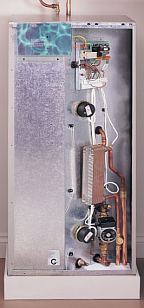
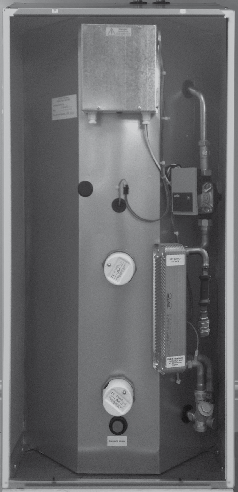
The early model Pulsacoil
(picture above right) used to use plate heat
exchanger technology to create mains pressure hot water. This
required a pump to circulate hot water from the store through the
exchanger. Water temperature was regulated by modulating the pump
speed according to feedback from temperature sensors. This function
and others of switching and timing utilised a micro
processor circuit board that can be seen near the top. The immersed
heat exchanger of the BP model simply relied on a thermostatic
blending valve to regulate output water temperature arguably a
simpler method.
|
|
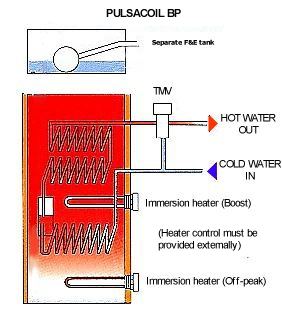
The PULSACOIL BP
The Pulsacoil BP utilises an immersed heat
exchanger (unlike the plate heat exchanger on the earlier type that
was situated within the cabinet but outside the store). This is to say the heat exchanger is immersed within the
hot water in the thermal storage compartment.
|
|
|
How Pulsacoil BP works
Mains pressure cold
water is passed through the immersed heat exchanger, is rapidly heated and exits as hot mains pressure water.
Temperature control is achieved using a thermostatic mixing
valve (TMV) on the outlet that limits the
maximum temperature water can emerge (usually set to approx 55oC).
|
 |
|
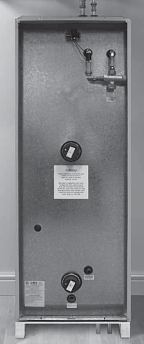
PULSACOIL STAINLESS (Circa 2014)
Early 2014 Pulsacoil changed yet again.
Notably, where copper had been preferred as the construction
material for the store now stainless steel would be used for
the first time.
|
|
It could be argued that stainless is
a little more resistant to corrosion and therefore the
machine would be better suited to hard water areas. However,
in reality the bulk of water in a thermal storage device
theoretically doesn't go anywhere, the store is filled and
that's that apart from a small amount of evaporation. So
once the water from the initial fill has done its deed there
is relatively little more going on. So, why stainless? Those
who are a little cynical have attributed the change entirely
to cost of material. Stainless is cheaper now than copper.
There may be a slight advantage to the resilient nature of
stainless but not the primary reason for the change.
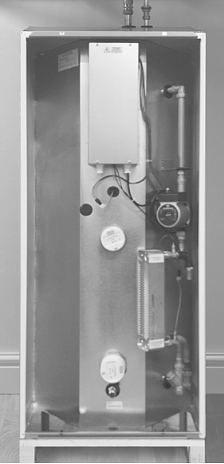
The PULSACOIL STAINLESS
could be described as a hybrid of all the earlier models -
with the only exception being that of build material.
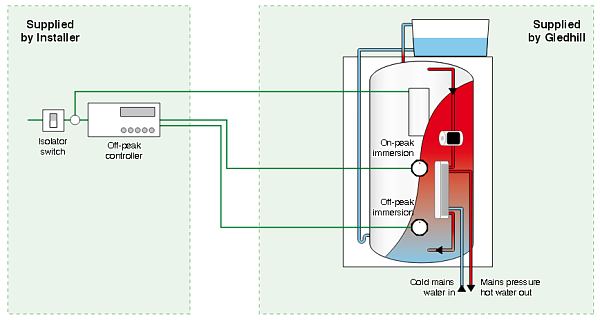
The PCS has re-introduced
the use of a plate heat exchanger and associated control,
although the switching of the immersion heaters is still a
matter for an external device which is not part of the
package you buy. Depending on which model you may be
replacing you may or may not have the necessary off-peak
controller already. |
 |
|
 |
|
=================================================== |
|
2015 |
|
All the benefits of previous
generations, but now incorporating a stainless steel thermal
store and low energy hi efficiency components.
The Pulsacoil ECO Stainless still
represents fantastic value for money and produces mains
pressure hot water safely. For
more information please see section directly above -
Pulsacoil Stainless
- or refer to the
Technical Manual
Need to replace your existing unit?
Pulsacoil Sales
Like to start a maintenance contract?
Call us
|
 |
|
|
=================================================== |
Conclusions about Pulsacoil
A safe vented unit producing mains
pressure hot water must be considered a good thing. Pulsacoil is
presented in a smart little cabinet (looking a bit like a filing
cabinet) which is pleasant in appearance. No requirement for a high
pressure vent pipe to atmosphere makes them simpler to install and
less obtrusive. However, since it's conception it has been
substantially modified throughout it's various guises.
Pulsacoil is just a thermal store
in a steel cabinet. The cabinet only performs an aesthetic function
and the internals only do what all other direct thermal stores do
(vented, 2 heaters, cold in, hot out).
Installation/retrofit of a
Pulsacoil:
Pulsacoil is a product that has become
a victim of its name. After all, what does it mean? The truth is
that the Pulsacoil is a very simple machine. It is an open vented
store of water (a bit like a bucket) heated by two electrical
immersion heaters (exactly the same as an Economy 7 cylinder). So...
why should you pay more to have a Pulsacoil fitted than a copper E7
cylinder? Yet, some plumbers would have you believe otherwise!
In short, Pulsacoil is delightfully
easy to install. There are no special qualifications (G3) required
for installation as the unit is open vented. The unit does not
require annual servicing. Mains pressure hot water is achieved by a
heat exchange process, which in reality is no issue as the machine
is set up to work once the simple installation instructions have been
followed.
PULSACOIL Value for money
Pulsacoil is offered by us at a very
attractive price. So good in fact that there is nothing else on the
market at present that can compete. |
| |
|
Alternatives to Pulsacoil
Pulsacoil is a thermal store. It
gathers electrical/thermal energy and converts this to mains
pressure hot water whilst remaining open vented itself. It is best
suited to small properties such a apartments and flats. For bigger
heavier applications you might consider Boilermate and Torrent
Greenheat thermal stores.
|
It has been our objective to explain:
-
what a Pulsacoil is
-
what function it performs
-
how it performs said function
-
the advantage of a thermal store
-
the difference between new and
older models of Pulsacoil
-
considerations when installing or
replacing
-
general conclusions
-
alternative product advice
We sincerely hope we have succeeded by
providing you with clear and objective information. This document
has been produced to help you (the end user or installer) make an
educated decision based on understanding.
You are always welcome to call our office for
more advice if you would rather discuss your requirement further.
If PULSACOIL is the product
for you please click here to
go straight to the appropriate product section.
2020
The New PULSACOIL STAINLESS (PCS)
In principle the PULSACOIL remains the same in
terms of operation. What has changed is the appearance.
The new PCS PULSACOIL is now cylindrical.
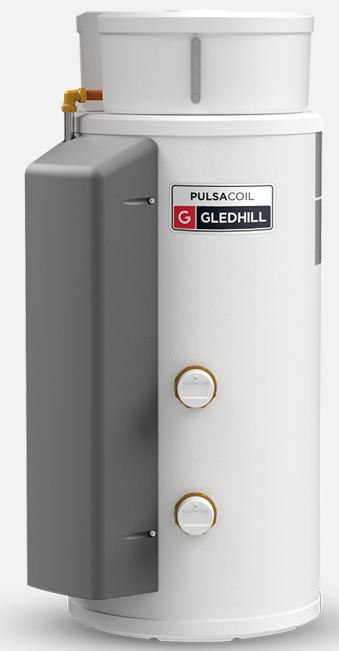
Constructed with a stainless steel water
storage compartment, the function of the PULSACOIL remains the same.
Mains pressure hot water from a thermal store that is heated
electrically.
There are however a couple of variations to
older versions above and beyond the shape.
The PCS PULSACOIL can now take heat from an
alternative secondary source.
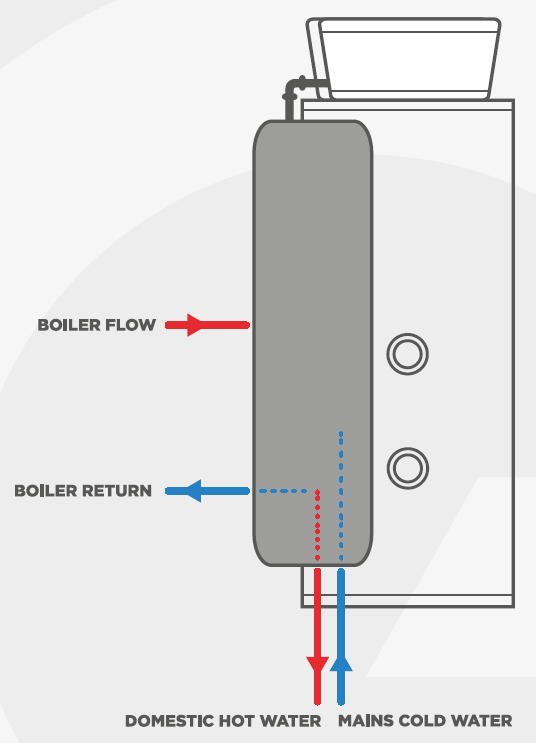
All models of the new PULSACOIL PCS are
available handed Left or Right. In effect what this means is 'which
side of the Immersion Heaters do you want all the pipework etc'?
The new cylinder sports a grey cover under
which you will find all the stuff previously on show on earlier
models - Plate heat exchanger, controls, pipe work etc. The grey
cover also offers a degree of energy saving by insulating what was
previous bare.
The optional handing places the grey cover (and
therefore everything under it) to the right or the left of the
immersion heaters. Strangely, Gledhill have decided to make the left
hand (LH) version the standard (pictured above). If you don't ask
for a right hand version you will simply get a LH model by default.
BUT, older models would by a similar criteria be considered 'Right
Hand' - where all the pipe work was on the right hand side of the
unit. So, if you are replacing an older PULSACOIL and you want to
minimise adaptation of existing pipe work you should bear this in
mind.
The PCS is available in 3 sizes - PCS150,
PCS180 and PCS 210. The two smaller models are supplied with a new
attractive F&E tank that compliments the shape of the cylinder and
sits neatly on top of it. The largest model still relies on an
oblong F&E tank that is more often sat on a shelf above the
cylinder.
It should be noted, the smaller circular F&E
tank is not compatible with most float valves, so will need to be
manually filled and periodically inspected to ensure there is water
in it. Having a larger F&E tank, the PCS210 model can be installed
with a live water feed to the F&E thereby fully automating the
process of keeping the requisite water level. (A live feed will
always require an overflow pipe from the tank).
A proprietary switching device will be required
in every case to manage the electrical supply to the heaters.
Back to the Gledhill Pulsacoil
PCS Stainless section
|