|
 |
|
Mains
Pressure Hot Water Systems
explained and compared!
|
|
|
Things you should know about the hot water
systems avaibale to you
|
Index Page
> Mains Pressure Hot Water Systems Explained
|
|
|
This simple
guide is intended to help you understand how mains pressure hot water systems work,
and in doing so help you to compare various products and system types from different manufacturers. |
| |
Mains Pressure Hot water
Systems - Explained
|
|
You may be considering installing
or changing a system to provide mains pressure hot water in
your home. Generally speaking, mains pressure hot water systems out-perform
the more traditional gravity systems by providing higher pressure and flow
rates, but there is a simple rule of thumb...
A mains pressure system is only as good as the
mains supply (Pressure and Flow Rate) feeding it.
A
mains pressure system may be an ideal choice for you, but
before you make your decision it is prudent to fully understand how these systems work and consider all the facts. |
|
The first and most important
thing you must understand is a mains
pressure system is only as good as the supply entering the property. This is
to say, the pressure you get at a tap for example is the product of the water
pressure entering the property from the water main.
The components and the
products attached to a mains pressure system do not in any way enhance the
pressure or flow rate that can be achieved within the system or at an outlet. For the avoidance
of confusion, if your incoming mains water pressure is poor then the
pressure at all outlets on that system will be poor.
Example: The product specification of a
piece of mains pressure equipment may for example boast 35 litres per minute flow rate at 3 bar
pressure. But if the water main and pipe work to the property can only supply 15 litres at 1 bar
then this is all you can expect to receive.
Although your mains pressure
equipment may be able to handle higher performance it is not capable of
increasing the supply pressure or flow. Figures quoted
against products are indicative of their potential based on an appropriate
supply. They are not necessarily a definitive statement of what you will get. |
| |
How do
mains pressure hot water systems work?
|
|
In a property with a mains pressure hot water system, all taps and water outlets
attached to that system will
have water at mains pressure - be they hot or cold.
It probably isn't difficult to understand that all cold taps or cold outlets are
connected directly to the same incoming cold water supply. Understanding where your hot
water comes from takes a little more technical understanding as it is still
fed directly from the incoming main but water must pass through equipment
designed specifically for heating it at pressure.
There are
different methods of doing this and many interpretations on product design.
Hopefully having read this guide you will possess a better understanding of
the various processes and be in a much better position to make an informed
choice (negating the risk of dependency on a pushy plumber or the need to
trust whatever half-baked nonsense you might be fed!). |
| |
Selecting your hot water system
|
|
Devices that heat mains
pressure water differ greatly from more or less all other types of hot water
heater. You should never try using a device designed to heat low pressure
water (a gravity copper cylinder for example) in a mains pressure system. A
low pressure copper cylinder which is typically fed by a cistern in a loft
operates under 'gravity' pressure (hence the term) which is in effect the
weight of water created by the higher position of the storage tank/cistern. The pressures
in a gravity system are typically much lower than those in a mains pressure
system of a typical house. Components designed for use on a gravity system are often
manufactured in a manner and from materials incompatible for use with high
pressure.
Warning: If you attempt to heat mains pressure water using a cylinder
designed for a low pressure system the risk of explosion exists.
The purpose of this article is to describe
how water may be heated directly from the main. To be correct one must
therefore acknowledge Combination Boilers as these too connect directly to
the main heating water instantaneously. As such, they are regarded as mains
pressure devices. We shall not however dwell on this type of
unit as they do not deliver the flow rate of a true mains pressure system.
In the field of domestic mains pressure hot
water the highest performing
systems require a cylinder. It must be noted however that the function and purpose of the cylinder may
differ according to which system you prefer.
There are
essentially two types of mains pressure hot water system -
The term vented and unvented refers to whether the system
is partially vented to atmosphere or completely pressurised and therefore
unvented. These terms might seem confusing and just a little contradictory so
we will try to explain more fully. |
| |
Unvented Mains Pressure
Systems
|
|
In an unvented system,
a vessel is filled with cold water directly from the incoming water
main. The vessel is kept under pressure from the incoming water
supply and heated either by immersion heaters (a direct model) or by
a heat source located outside the vessel such as a boiler or a wet
solar system (an indirect model).
The 'vessel' to which
we refer normally takes the shape of a cylinder. In an unvented
mains pressure hot water system the cylinder should be regarded as a
pressure vessel. This type of cylinder is referred to as 'an
unvented cylinder' because it is not vented to atmosphere in the
same manner as a normal gravity copper cylinder would be. Unvented
means exactly that - no open vents.
The unvented cylinder will have outlet pipe work
connected to it that will carry the heated contents around the property to
various taps and outlets. As soon as a tap or appliance is opened the pressure of the
incoming cold water to the cylinder forces (displaces) the contents of the
cylinder (hot water) towards the open outlet. Hence, hot water is
delivered to the tap or outlet at a pressure relative to the force of the
incoming cold water main to the cylinder.... Hence, mains pressure hot water. |
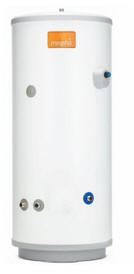 |
Examples of unvented cylinders include:
Stainless Lite
PLUS by Gledhill, or the Megaflo
Heatrae Sadia.
There are of course many others manufacturers and brands.
Unvented hot water cylinders have to
withstand considerable internal forces. Stainless steel is a popular
material for unvented water cylinders because of the high tensile strength
that can be achieved from a relatively thin sheet. Although a heavy gauge
copper may be used (and is generally regarded as a better water storage
material) the comparative cost of manufacture often makes this choice
of material prohibitive.
Before using a cylinder to store mains
pressure water you should ensure it was designed to do so. Failure to follow
this simple advice could result in explosion.
NOTE:
Unvented cylinders do represent a risk. Consider... you have a large volume
of very hot water in a cylinder under pressure. If the contents of the
cylinder were for example to get too hot (because of some system
malfunction) the risk exists that the contents of the cylinder could boil,
turn to steam and the internal pressure cause structural failure. We are
talking about explosion! To combat this issue all unvented cylinders must be
fitted with pressure/temperature relief equipment that will vent the cylinder in case of
such a problem.
To ensure that unvented cylinders are
fitted correctly, safely and by a competent installer the Government
introduced Building Regulations (G3). These Regs cover any vessel that
contains more than 15 litres of hot water under pressure.
NEVER
attempt to install an unvented cylinder unless you are trained to do so. The
consequences could be catastrophic.
If you have any doubts take a look at these:
http://www.youtube.com/watch?v=Cv178a60Ypg&feature=related
http://www.youtube.com/watch?v=iQK6McNdyXE&feature=related
https://www.youtube.com/watch?v=l3i_ZGPtm68
https://www.youtube.com/watch?v=0rXwcDkobUY
https://www.youtube.com/watch?v=fUkjXGfCLIM
https://www.youtube.com/watch?v=nY4zGQLnV6Y
Makes you think... eh?!! |
|
Having read about unvented hot
water systems it might seem somewhat of a contradiction that mains pressure
water can be achieved from a vented cylinder - but it can.
They say that the best ideas are the simplest.
Well, that could be argued about what's known as a 'Thermal Store'.
|
To the untrained eye a thermal store and an
unvented cylinder look very similar. They are typically cylindrical in shape
and the are both full of hot water. The difference is how they produce
domestic mains
pressure hot water.
Having covered the unvented cylinder in
the section above we shall now focus on the thermal store.
At the outset it must be said that one of
the most attractive properties of a thermal store is the fact that it is
vented. This is to say that the body (where the great volume of water is
stored) is at atmospheric pressure. It is therefore inherently safe as
dangerous pressure build up is impossible.
A thermal store is heated in exactly the
same way as any other cylinder (directly or indirectly). But unlike nearly
all others, the water in the cylinder is not destined to appear at
any taps or outlets - water is used solely to store a large quantity of thermal
energy (a little like the chemicals in a battery store electrical energy).
We therefore view the cylinder as a thermal battery or
thermal store.
The way a thermal store achieves mains
pressure hot water is by imparting the stored energy (from the hot water
stored at atmospheric pressure) into incoming cold water at mains pressure.
This is done by a process known as heat exchange and is achieved by
using.... (surprise surprise!)... a heat exchanger. |
.JPG) |
There are different types of heat exchange
device/method available with thermal stores, but essentially they all to the
same job - they take heat from the open vented source and transfer it to
mains pressure water as it passes through. In this way vented and unvented
can exist in proximity to each other but never mix.
Different heat exchange methods claim
different performance characteristics. Some are simple (immersed coil heat
exchangers for example), some may require more complex control (plate heat
exchangers for example).
Whichever method is used they all share
they all share they same benefit - mains pressure hot water from a vented
cylinder that is inherently safe.
Thermal stores, apart from being inherently
safe, offer several other advantages that are beyond the capability of an
unvented cylinder.
-
Thermal stores run much hotter than a
normal or unvented cylinder (each of which must be set at the temperature you
want water to arrive at taps). So, litre for litre a thermal store holds
more energy. To prevent any risk of scalding, the temperature of the
mains pressure water leaving a thermal store is governed. The method by
which this is achieved varies according to the method of heat exchange .
Some utilise a thermostatic mixing valve (a mechanical blending valve
that prevents water from exiting the cylinder above a set temperature),
whereas the 'plate heat exchanger type' will regulate the ratio of heat
given up to the mains water as it passes through the heat exchanger. The
latter will generally produce much higher flow potential as the heat
transfer process is more capable.
-
A thermal stores can accept multiple
heat sources simultaneously. Although this can also be said for vented and
unvented cylinders, more importantly thermal stores can accept heat from
a wider range including 'uncontrollable' heat sources such as wood burning stoves and Aga's that
cannot be turned up or down as required. They are also ideal for
appliances that operate by virtue of gravity (unpumped / thermo siphon)
circulation. (It is worth emphasising that an unvented cylinder
should never be connected to an uncontrollable heat source. To do so is
highly dangerous!)
-
As a thermal store is, as its name
suggests, a place where thermal energy is stored, it can be configured at
the 'centre' of your household hot water system, taking all sorts of heat
inputs (including wood burner, AGA, solar, ground source and air recovery) then give back
energy not only for domestic hot water, but also central heating, under floor heating
etc. This is achieved by taking additional feeds directly off the thermal store.
So, for example, a wood burner heats the store,
then hot water from the store is pumped off around radiators - the wood
burner now contributes to your central heating! Everything that
heats the store contributes towards its function. You may begin to
appreciate the versatility of this type of system.
-
You do not need to notify Building
Control when you install a thermal store. G3 Regulations only apply to a
vessel containing more than 15 litres of hot water under pressure. The
body of a thermal store is vented and there is less that 15 litres of
hot water in the heat exchanger. Thermal Stores are not governed by these regulations.
-
Because there is no inherent danger
with a thermal store they may be fitted by a competent person without
specialist training.
-
As a thermal store is open vented and
an internal build up of pressure is impossible, no pressure relief
equipment or pipework is necessary. As such, no annual inspection of
safety equipment is necessary saving the householder associated
ownership costs.
Thermal stores are particularly useful (and
in some situations essential) in conjunction with renewable energies fuels
and are available in various models including heat pump and solar. You might
like to take a look at some of the models:
|
What to Consider - Mains
pressure hot water systems
|
|
Unvented and vented systems both
provide hot water at mains pressure. They achieve this by slightly different
methods. There are however certain considerations when choosing the system
that suits you best.
Unvented Mains Pressure
Systems
|
-
Unvented cylinders provide mains pressure
hot water.
-
In an unvented system you will be storing
a large volume of hot water under pressure. For reasons of safety these
systems must be installed by qualified technicians with relevant
experience, CITB training and G3 certification.
-
As a precaution, pressure-relief pipework and valve/s must be installed
to protect against unsafe pressure build-up within the vessel which
could result in explosion. Pressure relief pipework must vent
outside the building.
-
Your Local Authority (Building Control
Dept) will need to be advised of your intention to install an unvented
system.
-
For reasons of safety, your system will
require an annual maintenance check to ensure safety equipment is functioning
correctly (BS2870).
-
An unvented system must be commissioned
and certified by the installer.
|
Vented Mains Pressure
Systems
|
-
Thermal stores provide mains pressure hot
water
-
By their vented nature, this type of
system does not store a large
volume of hot water under pressure. The Thermal Store, whilst containing
hot water, remains at atmospheric pressure.
-
There are no hazardous issues with a
vented system. Pressure relief valves and pipework are not therefore
required although a small F&E cistern is necessary for operation. This
may be remote or attached to the thermal store depending on
installation/operational necessities.
-
Vented systems
such as these do not require Building
Control approval.
-
Because of the simplicity and safety of
such systems, installers do not need certification or specialist
training.
-
Vented systems do not need certification.
-
There are no special annual maintenance
requirements or associated costs of ownership.
|
|
Other drawbacks and
considerations of a
mains pressure hot water system
|
|
Do not enter the realm of mains
pressure hot water systems (vented or unvented) unless you are aware of the
potential pitfalls.
Firstly, a mains
pressure water system is only as good as the supply to the property.
Sounds
obvious? If your pressure or flow rate (both are very important) are
questionable do not proceed. Once you install your system you have
what you have and there's little you can do about it. Be sure you check what
pressure your Water Authority is prepared to guarantee you. Some unvented
systems misbehave if the pressure is too low, but then again, why bother if
this is the case. A pumped gravity system with all its faults might be
better than a poor mains pressure system!
Improving performance of a mains
pressure system by adding pumps.
Under Water Bye-Laws you may not
add a pump directly to your mains fed system to increase pressure or flow
rate. If the supply in your house is poor there will be no simple way to
improve it.*
(*Recently,
a provision to fit a special small booster pump has been allowed. This is a
very small pump that will typically raise a low flow/pressure to 1bar with a
max flow of 12 litres/min. Often used in conjunction with Combi Boilers, the
wisdom of installing a full mains pressure system if your supply is that
poor should be seriously considered.)
Additional performance usually entails bringing in a new, larger
supply pipe to the property. Even then, you should ensure the new improved
supply will be adequate as some districts suffer from frustratingly low
pressure - something a bigger pipe won't fix.
Always remember -
your system can never be
better than the supply to it.
Mains pressure systems are driven by the
supply which is at the mercy of
fluctuations. This may not be an issue in the majority of
cases but should be considered before investment.
Mains pressure systems can give 'power shower'
performance, providing supply flow and pressure is good. If you like a vigorous
showering experience and your supply pressure is poor, remember - you cannot
install a shower booster pump to improve matters. Pumps may ONLY be added to
a gravity system (one with a tank of stored cold water).
You may need to change your shower equipment
Furthermore, mains pressure systems may
require you to change your shower valve/s. Because of the likelihood of
pressure (and/or temperature) fluctuations in the system you will need to
install either 'pressure balancing' or 'thermostatic' shower valves. Simple
'manual' valves can misbehave terribly manifesting huge temperature swings -
a very nasty experience!
If you previously had a power shower (one
with a booster pump either remote or all-in-one) these will have to come out.
Remember, no pumps allowed with a mains pressure system. Apart from
contravening Bye Laws, shower booster pumps are designed to be used with a
low pressure gravity feed. The high pressure nature of a direct mains feed
will more than likely blow the seals out of your pump and invalidate any
warranty you may have.
|
Compared
-
The Good
 ....and
the Not So Good
....and
the Not So Good 
|
Unvented
mains pressure system
(Unvented hot water cylinder) |
Vented
mains pressure system
(Thermal Stores) |
|
|
Mains pressure hot
water to all your taps |
|
Mains pressure hot
water to all your taps |
|
|
No loft tanks -
space saving |
|
No loft tanks -
space saving
(remember an F&E cistern is
required) |
|
|
High Pressure
storage cylinder |
|
Vented cylinder |
|
|
External pressure
relief pipework required |
|
No risk of
pressure build-up |
|
|
Specialist
installation requirements |
|
No special
requirements |
|
|
Annual maintenance
required |
|
No special
requirements |
|
|
Notification to
Building Control required |
|
No special
requirements |
|
|
|
|
|
|
|
|
|
|
And
Finally........ |
|
Make sure you check out the comparable -
|
 Cost
of purchase
Cost
of purchase
|
Installation |
Safety |
|
Maintenance |
Flow rate potential |
General
running costs |
|
|
|
|
|
|
|