|
We often hear people refer to....
-
The 'Hot Water Tank'
-
'Immersion Tank'
-
'The Immersion Heater'
-
The 'Hot Water Boiler'
.... when in fact they are actually talking about a Hot Water
Cylinder.
Water storage vessels are of course available in many shapes and
sizes, but it is common these days to find them cylindrical in shape
and often made of copper. Stainless steel is fast becoming a
favoured metal in the cylinder industry, but not necessarily for
some of the reasons given.
Stainless steel and Copper water cylinder
construction
Traditionally, copper has been the
favoured metal for hot water cylinder construction. More recently
stainless steel has featured in cylinder construction. With the
advent of unvented water storage stainless steel is used for it's
tensile strength. In other words, stainless steel is a much stronger
material and by comparison with copper will withstand the forces
and pressures contained within an unvented cylinder with a much thinner
wall thickness. (Copper can do the same but because it is softer the
wall thickness must be much greater.)
To simply state stainless steel is
however a little simplistic. Stainless steel is alloy and its
chemical composition determines different properties, albeit we just
call it all stainless. For example, one type of stainless might be
more resilient to salt water than another so is better for use in
maritime applications such as ships railings for example. Whereas,
another type is better in clean or clinical environments (e.g. Food
Grade Stainless). In certain environments stainless steel might be more resilient than copper, but don't be fooled into believing
that it will never corrode. Stainless just takes longer.
The simple fact is, Stainless steel is
a cheaper material to make a cylinder out of than copper - albeit
much more demanding to work with. So it is fast becoming popular
with manufacturers who can realise higher profit margins. Oddly
enough, these savings don't filter through to the retail price of
stainless cylinders!
For water storage copper offers many
advantages over stainless steel. Copper, as a metal, has an inherent antiseptic property.
That is to say it makes the environment within a cylinder a
difficult place for bacteria to breed. Copper in concentration can
be poisonous - just think what happens when you bang a copper nail
into a tree stump, it dies! So in the small quantities that dissolve
into water within a system it actually purifies.
Within the industry if you spoke
honestly with experienced tradesmen who make cylinders they would concede that copper is still
a better material for water storage.
Interestingly, now that stainless
steel has been used in cylinder production for some time certain
issues are becoming evident giving cylinder manufacturers cause for
concern.
Immersion heaters
Because many cylinders have at least one electrical 'immersion heater'
fitted they are mistakenly referred to as 'immersion tanks' or
'boilers'. Just for the record, an immersion tank is a tank in which
you might immerse something or someone (for example - hydrotherapy
utilise an immersion pool or tank), and although a boiler is an
appliance that heats water, such a device is typically used to heat
water in a wet central heating system with radiators.
A hot water cylinder is neither an
immersion tank nor a boiler as water in a domestic hot water
cylinder should never reach anywhere near boiling point. These terms
have been wrongly assumed because many hot water cylinders contain
an immersion heater (an electrical heater that is screwed in the
side or top thereby being immersed in the water contained within)
and may also be heated by a remote boiler. Plumbing terminology can
be most confusing at times!
Electrical immersion heaters are
simply a way to heat the water in a cylinder electrically. Some cylinders
use an immersion heater as a backup or emergency heat source whilst
utilising something like a gas boiler as the primary method. Such a
cylinder is generally referred to as an 'indirect' cylinder. If
there is no external heat source and the cylinder is heated
exclusively by electrical immersion heater or heaters the cylinder is
typically referred to as a 'direct' cylinder. (Historically the
definition of a 'direct' cylinder has changed, but the modern
understanding is as mentioned).
Economy 7 cylinders
These are specified as such because
they are designed to make the most of 'off-peak' electricity -
saving the user money with cheaper running costs. Economy 7
cylinders can be 'direct' or 'indirect' (exclusively heated by
electricity, or with the addition of an external heat source), but
they invariably utilise a two heater setup. The lower heater
typically being connected to the off-peak supply, the upper heater
being used as a manual 'boost' element and intended only for use
when a depleted cylinder needs to be partially reheated in a hurry.
Whichever type of hot
water cylinder you have, referring to it as an 'immersion tank',
'boiler', 'water boiler' etc is inaccurate and can be
misleading. Try and refrain from such descriptions as you might end
up ordering and receiving the wrong thing.
Hot water cylinder insulation
To avoid wasting energy and to comply with Building Regulations,
domestic hot
water storage vessels must be insulated.
Insulation helps the contents of the vessel stay hot for longer
and reduces the need to re-heat. By
reducing loss they work more efficiently and cost less to operate.
Insulation comes in several forms. Common types of insulation
include:
-
Sprayed-on foam
-
Insulating Jacket
The better your insulating jacket
the longer your water will remain hot. This saves energy (reducing
carbon emissions from generating heat and/or electricity) and in
turn reduces
the cost of maintaining a tank full of hot water.
In years gone by it was possible to purchase a bare cylinder (one
without insulation). This now contravenes regulations. All new
domestic hot water cylinders will be supplied insulated. You should
however understand although insulation is included when you purchase
a cylinder it is not included when cylinder sizes are stated or
discussed.
For example, a 1200 x 450 cylinder will actually be bigger according
to the thickness of the insulation. Maybe you can appreciate how confusing or misleading
a cylinder volume might be if insulation was included in dimensions
by one manufacturer but omitted by another. The more efficient the
insulation is the lower the standing heat loss.
Specifying the size of a replacement
Hot Water Tank or Cylinder
Remember when you are specifying the size of a replacement not to
include the insulation in your measurements. The industry see
insulation as an addition and therefore only refer to the size of
the bare cylinder or tank in specifications. Remember to check the
thickness of the insulation when ordering as this must be added to
the over all dimension of the cylinder or tank to establish the
finished size. For example:
- If the insulating
jacket on a cylinder is 30mm thick , you must add 30mm
to the height of the cylinder (no insulation on the
bottom) and 60mm to
the diameter. Remember, there is insulation on
either side of the cylinder.
Failure to observe this advice may result in you ordering a cylinder
that simply won't fit through a hatch or an airing cupboard doorway.
So remember
If you order a cylinder with dimensions of 1050 x 450 you will
receive an insulated cylinder measuring:
Height = 1050 + the thickness of
insulation, by
Diameter = 450 + (2 x the thickness of
insulation)
|
 |
Other terminology commonly used with
domestic hot water cylinders:
Immersion heater:
|
An electric
heater that typically screws in the top or the side of the
cylinder, is immersed in the water contained within and when
energised heats the contents. Immersion heaters are typically
fitted with a thermostat which can be adjusted on the cap by
turning the indicator dial. When power is connected, an immersion
heater will heat water until the set temperature is reached
then automatically cut out - turning on again automatically
if the water temperature should drop - all the time power
remains connected.
You don't really want or need to have your immersion heater
on all the time. To do so would be costly. So, immersion heaters are normally controlled by a timer (off
peak controller in the case on Economy 7) which energises
the heater at times you can program. Heaters can be
controlled by use of a simple on/off switch, but beware, if
you forget to switch off you can expect a thumping great
electric bill next time round!
Immersion heaters are prone to
corrosion caused by the water they heat. Periodically,
immersion heaters will need to be replaced. As a rule, cheap
heaters are more prone to the corrosive effects of water
than the dearer 'Incoloy' types. Incoloy heaters have an
alloy shroud over the element that protects from corrosion.
Although they cost more they represent a good investment as
they last a lot longer. |
Boss, or cylinder boss:
|
This refers
to a threaded fitting on the cylinder into which an
immersion heater, fitting or device
will screw. |
Tapping:
|
A threaded
hole that derives its name from the tool (a 'tap') used to
cut a thread. Also refers to where one might 'tap into
something' creating an outlet or inlet. In this instance, a
tapping is where
something connects into the body of the cylinder. A 'tapping'
is essentially a direct connection to the cylinder and is
made typically via a threaded fitting that can be male or female.
Compression fittings are also popular these days. |
Connection:
|
As the term
suggests, anything that offers a means of connecting to the
cylinder. |
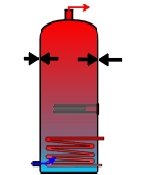
Coil:
|
This is a
term that typically describes a heat exchanger - because the
heat exchanger is coiled within the cylinder. Coils can be
used to impart or extract heat depending on design function. A
cylinder (or process) is normally referred to as 'indirect'
if a heat exchanger is used. |
Heat exchanger:
|
A device that
facilitates the transfer of heat from one medium to another
whilst keeping the two separated. It terms of a cylinder
this is typically a heat exchange between the heat generated
by a boiler (source) and the water contained within the
cylinder. Heat is exchanged or transferred. |
Indirect:
|
In cylinder
terms this typically refers to a cylinder heated by a remote
heat source. (see coil) |
Direct:
|
In cylinder
terms the modern interpretation of 'Direct' means the
cylinder is heated electrically with no external heat
source. In the past this term meant water from the cylinder
was taken out, passed through something like a back boiler
(that heated it ) then put back into the cylinder.
The latter process was often unpumped and known as 'gravity
circulation' or 'thermo siphoning'. |
Gravity cylinder:
|
On a modern
system this often refers to the fact that water to the
cylinder is supplied under gravity pressure from a header
tank sited above the cylinder (often sited in the loft). |
Gravity flow (heat source):
|
This has a
slightly different meaning to the above. Gravity flow (also
known as Thermo siphoning) is a process where water
circulates through the pipework by the principle of hot
water rising and cooler water falling. This process does not
involve or require pumps. Quite common with appliances such
a wood burning stoves, AGA's, Rayburns, Back Boilers, some
oil boilers etc. |
Gravity coil:
|
A larger bore
heat exchanger to facilitate good flow on a gravity flow
system - as outline above. Standard cylinders these days are
fitted with a 22mm boiler coil suitable for a pumped system.
A gravity coil is typically 28mm and must be requested when
purchasing. Do not overlook
the bore size of a cylinder's heat exchanger when
purchasing. A cylinder designed to be used on a pumped
system will not perform well on an unpumped system. Do not
be persuaded otherwise! |
Pockets and sensor probes:
|
When referred to as a
'sensor
pocket' this is usually a dry pocket located on the cylinder
into which a sensor probe can be inserted. Some cylinders
require multiple dry sensor pockets to monitor water temperature
gradients. If 'Wet' sensor
probes are used these will typically require a tapping into
which they will screw. The tip of the sensor probe will
therefore be immersed in the water contained within the
cylinder. |
Secondary return:
|
This is a
connection on a cylinder where return water from a pumped
'secondary return circuit' connects. SR circuits are
typically used to shorten the 'dead leg' or draw off time of
hot water at locations distant from the cylinder. Not
normally required in most domestic properties. |
Solar input:
|
This normally
refers to an additional coil placed low down in the cylinder
through which liquid from a wet solar collector system is
passed - imparting solar heat to the cylinder.
PV solar energy (electric) can
be supplied to the cylinder via an immersion heater. |
Vented cylinder:
|
An open
vented cylinder (or one designed as such) is (or should be)
vented to atmosphere. i.e. must not be connected directly to
mains pressure water or
configured in such a way that pressure can build up within.
Vented cylinders are filled by and normally breathe back
into
a header tank (or F&E, a reservoir of cold
water) sited above the cylinder, often in the loft. Or in the
case of a combination cylinder is a compartment on top of the
cylinder - physically attached.
Never connect a
'Gravity Cylinder' directly to a mains pressure water supply
or prevent the cylinder from breathing to atmosphere.
|
Unvented cylinder:
|
An unvented
cylinder derives it's cold water supply directly from the
cold water main. An unvented cylinder is a pressure
vessel. There are special requirements with regard to
installing and maintaining this type of cylinder.
Malfunction and/or incorrect installation can lead to
explosion, severe injury and death.
Advantage of unvented over
vented cylinders is better hot water pressure/performance
but comes with cost and strict rules . |
If you have any questions or would
like further explanation please don't
hesitate to call |
