|
Index Page
> Hot Water Cylinders
> AGA Hot water cylinders |
Domestic
hot water cylinders to be used with an unpumped heat
source
|
|
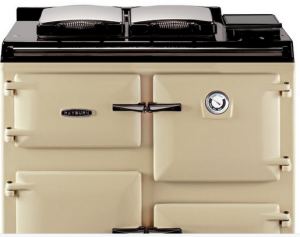 |
AGA, Rayburn, Wood Burning Stoves
|
 |
|
| |
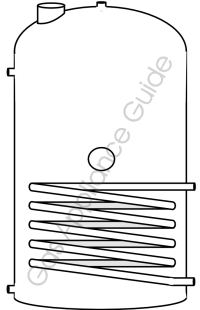
Gravity boiler coil - large bore
heat exchanger suitable for an unpumped heat source
|
|
An 'indirect' cylinder is
designed to be heated by a remote heat source. The typical
modern gas boiler produces a pumped circuit of hot water that
will heat both cylinder and radiators. There are however devices
that can produce a circuit of hot water that is unpumped, relying
instead on 'thermo-siphoning' or 'gravity circulation' to move
the water around the system. It is important to
match the type of cylinder to the heat source - pumped (as it would be
from a typical modern boiler) or unpumped (the sort of heat source
one might expect to get from a solid fuel or wood burning stove, an AGA or
Rayburn stove). The cylinder should also be a vented type*.
* Note:
Unvented cylinders (the pressurised type that provide mains pressure hot
water - e.g. Megaflo, Stainless Lite) should not be connected to a heat source that cannot be
fully controlled - the risk of explosion exists. Mains pressure
hot water can however be achieved in conjunction with a gravity
heat source by using a device such as a
Thermal Store.
For more
info please click on the links or feel free to
contact our office and we will be
more than happy to explain.
How an AGA cylinder differs
An AGA (for example) may produce
an 'unpumped' circuit of hot water relying on the
principle of
'thermosiphoning' (hot water rising and cooler water falling) to
create 'gravity circulation' within the system. A cylinder that
will happily accept an unpumped heat source is subtly different
from a standard cylinder in so far as the heat exchanger has a
larger diameter bore (28mm) and bigger connections (to
accommodate larger flow and return pipework). Connections may be
spaced slightly further apart improving the thermal dynamics and
therefore the flow.
Choose the correct cylinder for
AGA, Rayburn and Wood burning stoves
Do not connect a cylinder designed
for a fully pumped system to an unpumped system. The smaller
bore pipework and heat exchanger in a cylinder suitable only for a pumped
system would create a bottleneck and constrict the flow of a gravity system.
The strangled flow could
have significant implications for heat transfer dissipation. Please ensure
you mention the heat source/s you intend to connect when
ordering to ensure you get the right advice and the correct
product. |
 |
A remote heat source with a Direct
connection
Although unusual these days, there
are systems that have a remote heat source that directly heats
the water. This is to say the water in the cylinder travels to
the heat source, is heated, then travels back to the cylinder.
This is a traditional type of 'direct' system which requires no
heat exchanger in the cylinder (only direct tappings). For this
to work without contaminating the water the heat exchange
process must take place in a non-ferrous heat exchanger at the
boiler end. Such a heat exchanger might be ceramic or made of
copper. If your cylinder requirement is for this type of system
please call. |
|
-
28mm big bore boiler coil gives better gravity
flow and more efficient heat exchange
-
28mm boiler connections facilitating larger
flow and return pipework
-
22mm connections
for cold water 'feed' and hot water 'out' (This may be
altered if required)
-
Tappings to suit
You can specify position
of connections if required (Sketch recommended)
-
Immersion Heater side or top
Top or side mounted
immersion heater boss if and as required (please state)
-
Fully
Insulated
All cylinders are supplied
insulated and fully compliant with Part L.
-
Please note, the
thickness of insulation (*allow
nominal 50mm on either side) whilst included is not stated in the dimensions.
Please ensure the cylinder will fit the space you have
available.
(Example: 450
stated diameter + 50mm either side (2x50) = 550mm
finished diameter)
|
|
INDIRECT Copper
Cylinders for use with AGA, Rayburn, Wood Burners and unpumped
(gravity flow)
indirect heat sources
|
|
Systems that generate a a gravity heat
source are often deemed 'uncontrollable' as they cannot be turned
up/down or on/off as required (For example: Wood burning stoves). With
this type of heat source provision should be made to
'bypass', 'dump' or 'leak' heat away from the cylinder or the heat source to
prevent the risk of overheating, boiling or evaporation. One way to achieve
this is by utilising a bypass valve and heat leak radiator.
In general, but only as a rule of thumb,
it is considered that an 'entry level' cylinder in such a system should
contain in the region of 140 litres of water as a minimum. This
figure may differ according to your hardware. Please refer to your system
specification or stove manufacturer before placing an order.
|
Size and Price
list
Open vented
cylinder with large bore heat exchanger for use
with gravity flow heat source
Please note, the
thickness of insulation (*allow
50mm on either side) whilst included is not stated in the dimensions.
Please ensure the cylinder will fit the space you have
available. |
.jpg) |
|
Cylinder
Size (mm) |
Nominal Capacity |
Imperial Size Equiv |
£ inc
VAT |
|
1200 x 400 |
136 |
48 x 16 |
495.58 |
|
1500 x 400 |
170 |
60 x 16 |
547.83 |
|
1050 x 450 |
144 |
42 x 18 |
473.59 |
|
1200 x 450 |
166 |
48 x 18 |
518.97 |
|
1500 x 450 |
222 |
60 x 18 |
564.93 |
|
1800 x 450 |
268 |
72 x 18 |
688.36 |
|
1200 x 500 |
193 |
48 x 20 |
874.36 |
|
1270 x 500 |
218 |
50 x 20 |
931.59 |
|
1500 x 500 |
248 |
60 x 20 |
969.98 |
|
1800 x 500 |
276 |
72 x 20 |
1042.98 |
|
1200 x 600 |
305 |
48 x 24 |
1417.93 |
|
1500 x 600 |
385 |
60 x 24 |
1450.22 |
|
1800 x 600 |
454 |
72 x 24 |
1746.50 |
|
|
|
|
 |
|
For other modifications
please don't hesitate to
ask
|
Additions and optional
extras |
|
Options available
at additional cost include: |
|
| |
Compression fittings (instead of threaded bosses per 4) |
19.50 |
| |
Shower take-off |
19.50 |
| |
Additional Tappings
(pairs) |
18.00 |
| |
Secondary return |
12.00 |
| |
| |
Immersion Heater (Incalloy)
3kW alloy coated (corrosion resistant) |
£36.00 |
| |
Drain
(threaded boss) |
9.50 |
| |
Ball valve and overflow
fittings (combination models - supplied loose - not installed) |
19.00 |
| |
|
|
| |
Additional immersion boss
(already supplied with one) |
18.00 |
| |
Gravity
boiler coil with 28mm connections (Large bore for AGA,
wood burner etc)
Please see
this section |
£95.00
(Please add to stated price) |
|
Positioning tappings to your specification does not
normally attract a supplementary charge |
| |
|
|
|
|
|
|
The following represents
the full range of cylinders available with 'gravity' heat exchangers. As
mentioned, please check with your hardware manufacturer for the
recommended minimum size of cylinder for your installation. These may be
suitable for systems where the heat source has a low output. |
|
900 x 300 |
55 |
36 x 12 |
POA |
|
1050 x 300 |
65 |
42 x 12 |
POA |
|
1200 x 300 |
75 |
48 x 12 |
POA |
|
1500 x 300 |
96 |
60 x 12 |
POA |
|
1800 x 300 |
114 |
72 x 12 |
POA |
|
900 x 350 |
74 |
36 x 14 |
POA |
|
1050 x 350 |
90 |
42 x 14 |
POA |
|
1200 x 350 |
103 |
48 x 14 |
POA |
|
900 x 375 |
87 |
36 x 15 |
POA |
|
1050 x 375 |
103 |
42 x 15 |
POA |
|
1200 x 375 |
118 |
48 x 15 |
POA |
|
750 x 400 |
80 |
30 x 16 |
POA |
|
825 x 400 |
89 |
33 x 16 |
POA |
|
900 x 400 |
96 |
36 x 16 |
POA |
|
1050 x 400 |
114 |
42 x 16 |
POA |
|
675 x 450 |
86 |
26 x 18 |
POA |
|
750 x 450 |
95 |
30 x 18 |
POA |
|
825 x 450 |
109 |
33 x 18 |
POA |
|
900 x 450 |
117 |
36 x 18 |
POA |
|
| |
|
|
Friends of Gas Appliance Guide
#
Mobility Depot
Walk in Baths
Low level, Tub style & Baths with lift
All-in-one leak free shower pods with WC
Carer assistance half height shower cubicles
Seat Seats, Rollators, Grab Rails
Scooter bugger accessories
|
 |


.jpg)
.jpg)