Gledhill Boilermate
The product known as 'Boilermate' has
been around for a long time. It has however evolved during this time
and if you are replacing an elderly unit (or for that matter
planning to incorporate one in a new installation) you should be
aware of fundamental differences between old and new models.
What is a Boilermate?
A Boilermate is a Thermal Storage unit. But the
full answer to this rather depends on
the age of the unit as the function and
appearance has somewhat altered over the years.
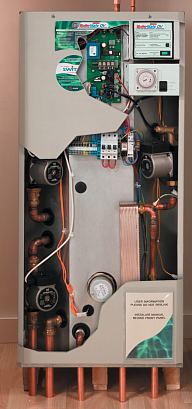
Pictured right you
will see a Boilermate A Class OV - very different in appearance to a
Boilermate II for example, or the newer Boilermate BP shown below.
A thermal store, as the name suggests, is
something that stores thermal energy. Thermal stores, as they are
generically known, are available from different manufacturers and
typically store their energy in a mass of water contained within the
unit which is open vented - this is to say the water stored is at
atmospheric pressure, not sealed, pressurised or 'unvented'. Rather like a
massive bucket. Gledhill (the manufacturer of Boilermate) took the
principle of an open vented thermal store (a concept favoured for
it's safety when compared to unvented systems) and incorporated
several functions into their unit and gave it a snazzy name.
As mentioned, the Boilermate unit has
changed both in appearance and function due to product development
(and other factors) over the years. The earlier models looked like a
cylinder with various pipework, whereas newer versions resembled
a rather unassuming office cabinet with concealed pipework.
Interestingly, the most recent version (2020) is cylindrical once
again.
|
 |
What function does a Thermal Store
perform?
The core function of a thermal store
is to collect and store energy. Hence, a Boilermate is an energy
store. But, the Boilermate (depending on model) utilises the stored
energy to perform other domestic services. The most desirable
function of a thermal store (and therefore a Boilermate) is to
provide provide mains pressure hot water whilst remaining safely open
vented. A contradiction you might
think (mains pressure hot water from an open vented store?) but this
is the somewhat clever part - heat contained within the store is
simply imparted to mains pressure cold water passing through the
unit. The method by which this operation is achieved marks the
difference between products offered by manufacturers and indeed the
different models within the Boilermate range.
What function does a Boilermate
provide
To answer this fully rather depends on the
version of Boilermate.
Going back, the 2000 and A Class models were an 'all-in-one'
hot water and central heating management system contained
conveniently and neatly in an unobtrusive beige cabinet. Considered
ideal for rapid and almost foolproof installation, the unit could be
wheeled in and with a few simple connections central heating and
mains pressure hot water were achieved.
Designed to work
in conjunction with a boiler (hence the name 'Boilermate')
the product soon became popular with major housing developers not
only for it's performance but also for it's ease of installation. Delightfully simple for the
plumber, a full water management system in a single product - and no
fiddly items of valuable stock for the developer to leave on site
and keep an eye on!
Evolution of Boilermate
Over many years the Boilermate has evolved from a
cylindrical thermal store (pre-2000) with a host of visible pipes and external
components into a neat cabinet containing everything the unit needed
to perform it's function concealed behind a removable front panel.
Mains pressure hot water, a fully open
vented store (a great safety feature), central heating control,
boiler control, all the pumps and gadgets needed to manage household
requirements were incorporated into the Boilermate.
As the product
continued to develop (Boilermate 2000 and later) the unit saw the
introduction of an optional 9kW electric boiler that could be used
in emergencies if the main boiler were to breakdown. This feature
became a standard fitment on the Boilermate 'A Class'. Little by
little the unit became more and more 'clever'.
How do you get mains pressure hot
water from an open vented thermal store?
The principle is simple, although
achieving it is somewhat more complex. What appears to be a contradictory scenario
is achieved through heat exchange.
Heat exchangers are utilised to
take pre-heated water from the thermal store (which is open vented)
and impart the energy into the mains pressure water passing through
the unit via a heat exchanger. It's as simple as that. All of the dangers (risks of
explosion) associated with unvented cylinders simply disappear
because an open vented store cannot become pressurised. So you get all the
benefits of mains pressure hot water with none of the risks.
Reliability of the Boilermate
The Boilermate continues to be a good idea. To
exploit elements that safely deliver mains pressure hot water
without any of the dangers must be a good thing, but Boilermate hit
a bit of a problem - it became complex.
Boilermate had developed into an entity that required an
electronic brain. Although heat exchange
technology is simple to achieve, stabilising output temperature
opened up a new can of worms. In order to utilise a plate heat
exchanger with a high flow potential AND achieve a stable output
temperature the speed at which water from the store was pushed
through the heat exchanger had to be regulated, taking into account
things like the speed of flow and temperature of the incoming mains
water. Then there was the temperature of the store water which would
be constantly changing. A target hot water output temperature of 55
degrees C was achieved by modulating the pump circulating the store
water through the heat exchanger accordingly.
Control required a
microprocessor which of course gave rise to the need for electronics
and circuit boards. Electronics took over the control of all system
functions. With complexity can come an increase of things to go
wrong. Whilst generally reliable, if something did go wrong there
were precious few plumbers who felt able to understand let alone fix
such a unit. You were likely to get injured in the rush for the door
as the tradesperson legged it!
Plumbers were alarmed when they saw electronics
and circuit boards and would often jump to the wrong diagnosis if
fixing a problem - blaming a circuit board (the most expensive bit)
for example rather than a simple temperature sensor (the cheapest
bit).
Suffice to say, finding a willing plumber was
difficult, but finding one who could understand the Boilermate could
prove very tricky. |
Getting a Boilermate fixed
In reality the function and principle
of Boilermate is not all that complicated, it just needs a willing
and open mind. Principles of thermal storage are in themselves
fairly easy to grasp, but many plumbers either can't be bothered or
become petrified at the thought of learning something new. For this reason owners of Boilermates around
the country are happy as can be while they work, it's when they go
wrong it becomes apparent that help is in short supply.
Models of Boilermate up to
and including the 'Boilermate A Class' were good at what they were
designed to do so long as they didn't go wrong. It can be difficult to find a person who will
understand and tackle a repair. Spares can be a little pricey.
The new generation of Boilermate
Towards the end of the 2000 decade the
Water Storage division of Gledhill that manufactured the Boilermate
went into liquidation. It's reliance on the 'new build' housing
market proved to be the downfall. Boilermate as we knew it ceased to
be.
However.... Gledhill is made up of
several divisions, so manufacture of the Boilermate range (along
with other products) transferred to the Building Products division. From
then Boilermate would carry a 'BP' suffix.
The Boilermate BP
When the Boilermate product was
transferred to the Building Products division of Gledhill it
underwent a major change. Taking a positive view of the
changes one might argue that the product was improved by removing
all the complicated technology required to run the older model.
As mentioned earlier, the Boilermate
had become complicated and required microprocessor control for time
functions, pump speed modulation, switching etc etc. By utilising a
different type of heat exchange mechanism (an immersed heat
exchanger) the new BP model no longer requires a store pump or the
associated control.
|
Furthermore, where the older model controlled DHW output
temperature by varying the heat exchange process (by modulating pump
speed) the new model simply uses a TMV (thermostatic mixing valve)
on the outlet to limit the temperature that hot water can be
delivered to taps. Yes, it is great that a simpler way to achieve
mains pressure hot water had evolved, but it came at a price.
How does the Boilermate BP differ
The concept of Boilermate was (in the early
days) a total water management system that could deliver mains
pressure hot water and control the central heating.
But things changed.
Not only did the Boilermate BP change how it
created hot water (utilising an internal coil heat exchanger rather
than an external plate heat exchanger) but it no longer had any
control or function relating to the central heating.
Furthermore, the Boilermate BP was stripped of
all electrical control devices (i.e. timers, electrical temperature
sensors, pump controllers etc). From then on, all control devices
would need to be provided externally.
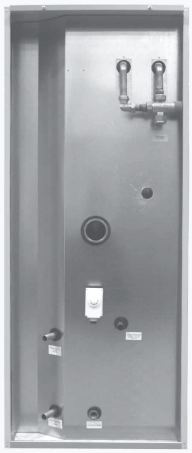
(Please see
Boilermate BP unit picture right - front cover removed)
The Boilermate BP would need to be incorporated
by means of a traditional 'S' or 'Y' plan
configuration - Just like a tradition copper cylinder might be.
|
 |
The evolution
continues... |
|
BOILERMATE
BMSCP
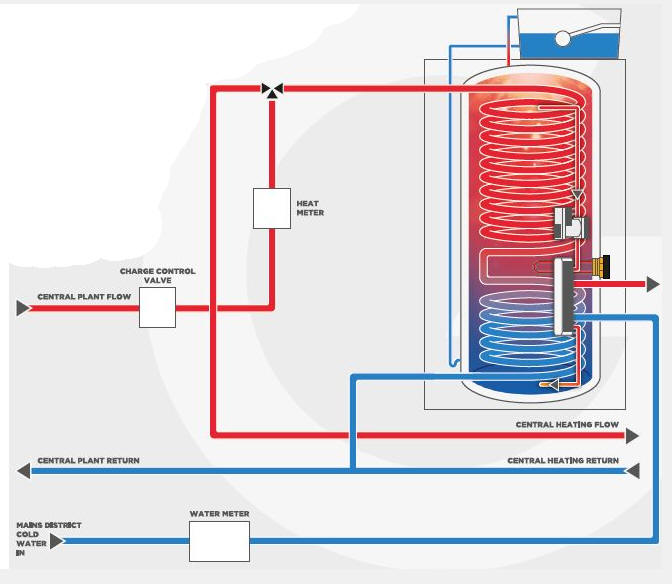
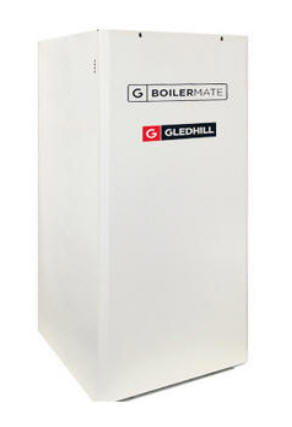
Boilermate continued to
evolve and passed through the BOILERMATE BMSCP model
(seen right with schematic below), which was the first to
utilise stainless steel in the construction. A hibrid of
previous technologies, the BMSCP show the re-introduction of
a plate heat exchanger for the DHW but incorporated a large
boiler coil for heat input to the store.
BMSCP denoted
'stainless central plant'.
 |
 |
2020 - The Boilermate
Stainless
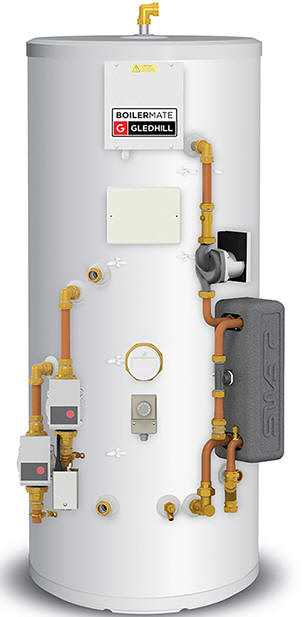
2020 sees the Boilermate Stainless available in
two types. The OV (a fully open vented model) for use in a fully
open vented boiler and heating system. And the SP model that allows
connection to a pressurised boiler primary circuit and radiator
system. The store on models of Boilermate continue to remain
open vented and all models produce mains pressure hot water.
BOILERMATE STAINLESS fully open
vented (BMST OV)
This
model is pictured above. The most striking difference to models
manufactured over the previous 20 years is the return to a
cylindrical shape.
There
is also a return to the days when a heating system could be run
directly from the store (i.e. boiler heats the store, store supplies
pre-heated water to the radiators). Mains pressure water still
remains a primary function from an external plate heat exchanger.
The BMST OV is ONLY available as a
'pre-plumbed' unit. This is to say you simply hook up to
connection points on the cylinder pre-plumbed by the factory during
manufacture.
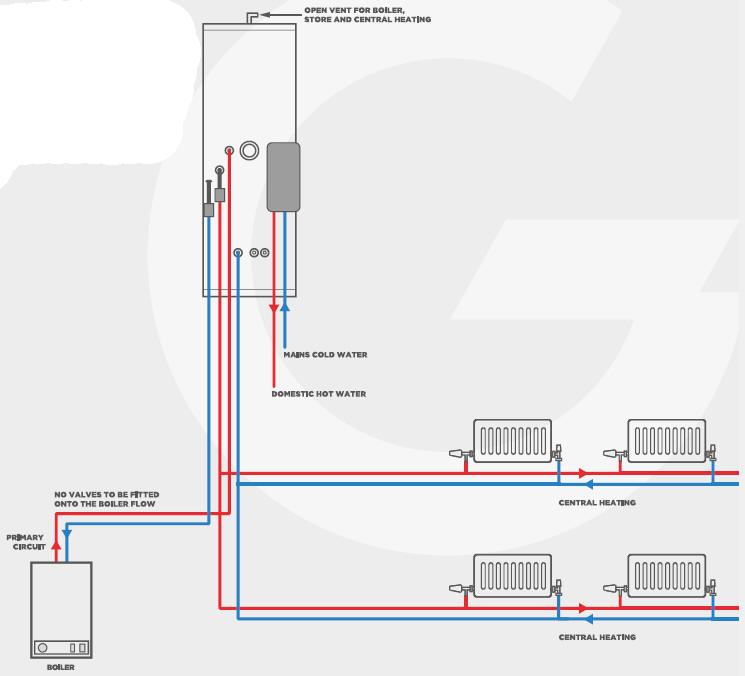
The BOILERMATE BMST can supply heating and hot
water. It includes the brain to control DHW temperature and also the
boiler and heating circulating pumps but boiler and heating controls
(programmer) must still be added.
BOILERMATE STAINLESS sealed primary
(BMST SP)
The SP
Boilermate is still a vented thermal store, but can be used with a
heat source such as a system boiler with a pressurised primary
circuit.
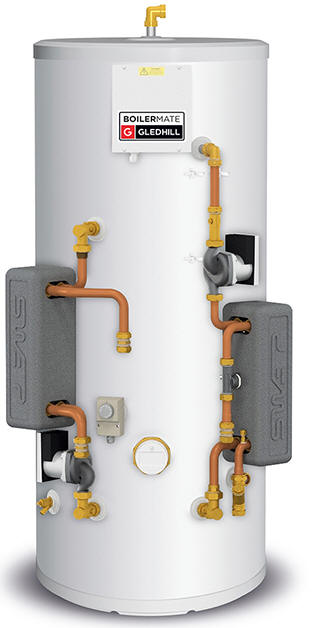
Heat
can be introduced to the cylinder from a pressurised primary via
another plate heat exchanger (PHE). Now you have one PHE putting
heat into the store and a second PHE creating hot mains water by
extracting heat from the store. Meanwhile the store remains vented
for maximum safety.
There
is however a slightly different plumbing schematic (shown below)
with which the boiler heats the radiators.
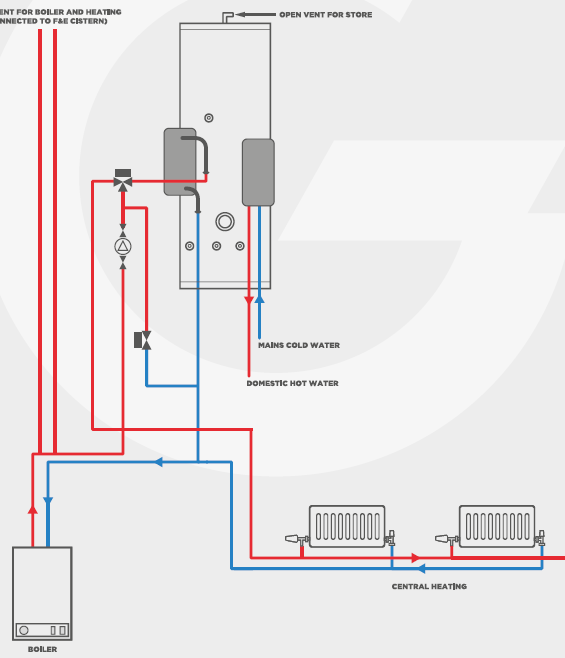
The BOILERMATE Stainless SP model is available
in various sizes and as either a standard cylinder (shown above) or
a pre-plumber version (shown below).
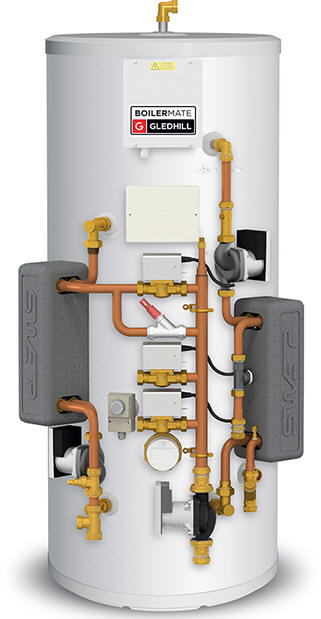
Although more expensive, the pre-plumbed
Boilermate (PP) saves time on installation (simply hook up to
pre-plumbed connection points). Cylinder includes pumps, zone valves
and bypass.
Your heating system will require a programmer
to be added (not included with either type of cylinder).
For further information on the newest addition
to the BOILERMATE family please follow this link...
BOILERMATE STAINLESS
Alternatives to Boilermate
Now that Boilermate is simply a
thermal store in a box, and because we know you will need to
modify existing pipework during the process of replacement, you are of course
no longer 'tied' as it were to the product. Replacement (if you wish
to stay with the technology) will involve you buying a new thermal
store (this is all a Boilermate is now) so you are at liberty to shop about.
In an attempt to keep things simple we
will assume you wish to continue enjoying the benefits of mains
pressure hot water together with the safety of an open vented
thermal store. So which way should you go?
Top of the list must of course be to
install a new type Boilermate BP. Perfectly understandable if you
desire the cabinet style of the Boilermate BP. Just be sure you
understand the differences between the new and old models and the
alterations to plumbing and controls you will need to undertake. And remember, Boilermate BP is
just a thermal store in a box. Nothing more.
If you are less concerned about 'the
box' in which the Boilermate houses its store then you might like to
look at a cylinder type thermal store.
There can be numerous advantages in
considering a proper cylinder shaped thermal store. Not least is the
fact that you can run heating directly from a cylinder type store
should you wish in much the same way as the old Boilermate models
used to. In short, cylinder type thermal stores are more versatile.
Depending on the model you choose, cylinder type thermal stores will
accept multiple heat sources simultaneously, provide mains pressure
hot water AND remain open vented. They are therefore much more
versatile than the Boilermate BP.
Which cylinder type thermal store
should I choose?
Firstly you should take a look at the
various options available to you. Gledhill (the manufacturer of
Boilermate) make their own cylinder type thermal store called the
Torrent Mulitfuel Store. Gledhill, in keeping with the company's
propensity to brand their products with catchy names, have
christened their thermal store cylinder with a name that describes
the cylinder's function quite well. It is however only a thermal
store and arguably does nothing more than other similar products.
You might also like to look at an
alternative range of thermal stores that are available (follow
the link for full info). These cylinder type thermal stores haven't been given
snazzy names they simply perform the same
function.
You might be interested to know that
the Gledhill Torrent Multifuel store is available ONLY as described.
The alternative cylinder however can be adapted and/or modified to
customer specification and is available in cylinder and combination
versions.
Thermal store cylinders can generally accept heat input
from various sources such as solar, wood burners, AGA's, oil and gas
boilers, air recovery and ground source heat pumps. The process is
simultaneous, they remain open vented and all provide mains pressure
hot water.
A thermal store is in some ways unique
as it possesses the ability to accept heat from sources that are
deemed 'uncontrollable' such as wood burners and AGA's. The
inherently open vented nature of a store makes this possible without
the risk of explosion.
Check them all out before you decide
as there is often a price differential that cannot be ignored. You are
always welcome to call our office for advice if the going gets a
little tough!
Back to the
Boilermate BP section
|
