Direct and Indirect horizontal vented hot water cylinders
Can be
built to your specification. Supplied as direct or indirect patterns
and complete with cradles.
|
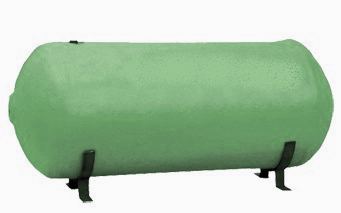
Above: Typical horizontal hot water cylinder with support cradles
(Colour and type of insulation may change)
|
So what's the difference?
Horizontal cylinders differ greatly
from their vertical counterparts. For example, a vertical cylinder
has a convex top and a concave base. When a cylinder is manufactured to lay on it's side
so to speak it is manufactured with two convex ends.
Connections on a horizontal hot
water cylinder.
Everything about a horizontal hot
water cylinder differs to the vertical counterpart. Vertical cylinders
tend to have the cold water feed on the side at the bottom with the
hot water draw off in the middle of the dome at the very top.
Because the domes on a horizontal cylinder are not at the top the
location
of these tappings also needs to be repositioned accordingly. |
The cold inlet on a horizontal cylinder
is normally positioned on the bottom of the vessel at one end.
The hot water draw-off is usually on
the top of the vessel at the opposite end to the cold water inlet.
A horizontal cylinder requires support.
The cylinder cannot just lay on it's side on the floor, it requires support. For this
reason, horizontal cylinders can be supplied with a steel cradle. The
cradle also stops the cylinder from moving - a full cylinder
becomes very heavy! You are of course at liberty to devise or make your own
support. Factory cradles hold the cylinder approximately 100mm above
the surface upon which it is supported, so remember to factor this into any
measurements. (i.e. Cylinder diameter + insulation thickness + 100mm cradle
height)
A slight slope
A horizontal cylinder should be installed with
a slight slope up towards the hot water draw off point. This encourages air
bubbles to work their way toward the vent, preventing the build-up of
an air pocket along the upper edge.
|
Boiler connections on an indirect
horizontal hot water cylinder |
|
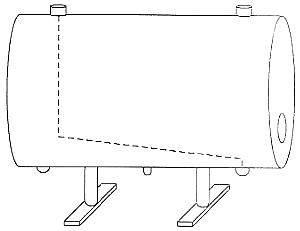
Connections and internals on a horizontal
cylinder are very different to those found on a standard vertical hot water
cylinder. To illustrate this point, consider laying a vertical indirect
cylinder on it's side. The boiler water that was previously travelled in a
descending coil would now be effectively travelling in a rising and falling
motion - and near to one end only. This would cause many problems and would not work
efficiently. So in a horizontal cylinder the heater exchanger (boiler coil)
is modified to travel along the lowest part of the cylinder (in the coolest
water) from one end to the other. The boiler 'flow' is fed in through
the top of the cylinder, down to the heat exchanger at one end and returns
to the boiler through the bottom of the cylinder at the other end. |
 |
The cold water feed to
the cylinder is typically on the underside of the cylinder below the point
where the boiler flow connects and the hot water draw-off in on top of the
cylinder above the boil return (as is the vent connection and shower
take-off if required).
The afore mention connection points can vary
according to cylinder function and manufacturer. For example, some
horizontal cylinders have connections in the domed ends.
A tapping for a drain is often
considered a good idea and can be incorporated on the lower side (bottom) of
the cylinder body.
Horizontal hot water cylinders with immersion heaters
Horizontal hot water cylinders can be fitted
with immersion heaters just like a vertical cylinder might. However, to keep
the element/s as low in the cylinder as possible it is preferable to have
immersion heaters fitted in the end/s of the cylinder.
Horizontal hot water cylinder and shower take-offs
A shower take-off can be
fitted to a horizontal hot water cylinder. The purpose of a dedicated shower
take-off is to draw hot water from a
level just below the top of the cylinder. In doing so air bubbles (which
naturally rise to the top) are prevented in the main from entering this
dedicated feed to a shower booster pump and negate problems one might
experience without such a fitting such as cavitation. (Ordinarily you would
need to purchase a device known as a 'Surrey Flange' to do such a job at extra cost.)
Horizontal cylinder fed by an 'unpumped'
heat source.
It is possible to heat a horizontal cylinder with an
unpumped heat source such as a wood burning stove or an AGA. Unlike the heat
in a typical household system in which hot water from a normal gas
or oil boiler is moved by a small circulating pump, unpumped heat sources
(as their name suggests) do not utilise a pump in to circulate water
through the heat exchanger, instead they rely on what's known as
thermosiphoning - a gravity
flow created by the action of warm water rising in external pipe work and cooler water falling.
To explain further, water heated by the appliance (AGA, Rayburn, woodburner, etc) is hotter than water returning
from the cylinder, so when pipe work is configured correctly hot water will rise
to the cylinder, give up its energy, then return to the heating appliance as
cooler water
for the cycle to repeat itself - a circulating flow being created. This is
an 'age old' and very simple principle which is quite effective. You will
however need a larger bore heat exchanger in the cylinder than the
type used in a fully pumped system to ensure a good flow of water for this gravity principle to work well. Do not use a cylinder
designed for a pumped heat source on a system relying on gravity
circulation.
Horizontal hot water cylinder with gravity boiler coil.
Horizontal cylinders
can be made with a gravity coil (for an unpumped heat source), but you must
specify this requirement. Failure to do so will result in you receiving a
standard cylinder suitable for use on a pumped system. A gravity boiler coil
is a little more expensive than a pumped coil for the simple reason it is
larger. Please refer to price tables.
Options for fittings. We can supply
your cylinder with various types of connections depending on your
requirement and preference. We can also configure your cylinder with the
tappings (connections) in positions that best suit your installation. If you
have special requirement you are welcome to call
and discuss your installation before
making purchase to ensure we arrive at the best possible solution.
UNVENTED HORIZONTAL HOT
WATER CYLINDER
Frequently Asked Question
Q. Can you supply a horizontal unvented
cylinder to provide mains pressure hot water?
A. Yes. We are able to supply mains pressure
horizontal hot water cylinders manufactured from either Stainless Steel, but
not on this page. Please call for advice.
All the cylinders offered on this
page are 'vented type'. Under no circumstances must the inlet be connected
directly to mains pressure water. |